
Cloud systems are now the core infrastructure of modern business operations. Almost every critical function such as applications, data storage, customer services, internal communication, and transactions depends on cloud platforms. Because of this deep dependence, even a small disruption can affect business continuity.
Cloud resilience refers to the ability of a cloud system to continue working during failures and recover quickly after disruption. It is not something that can be assumed once and trusted forever.
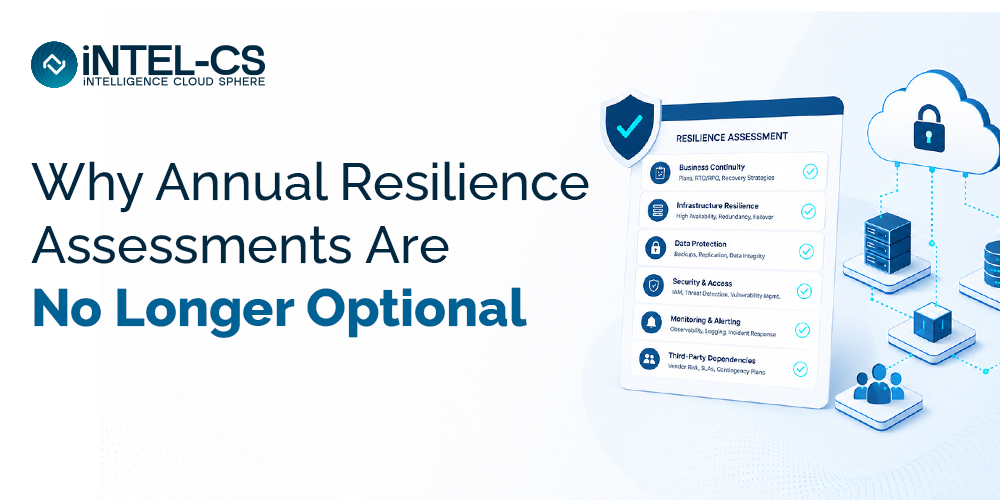
This is why annual cloud resilience assessments have become a necessary practice. They ensure that cloud systems are still strong, still recoverable, and still capable of handling real world failures as environments evolve over time.
Cloud Resilience Cannot Be Treated as a One-Time Exercise
Cloud systems are not fixed environments. They are dynamic and constantly evolving as businesses grow, scale operations, and update digital services. Because of this continuous change, cloud resilience is not something that can be validated once and assumed to remain valid forever, even in structured environments such as iNTEL-CS cloud operations and management frameworks.
A one-time assessment only shows how the system performs at a specific point in time. It does not reflect how the environment behaves after weeks or months of changes, updates, and new integrations. Over time, this creates a gap between what organizations assume about their resilience and what actually exists in the live environment.
As this gap grows, the risk of unexpected failure also increases.
Initial Cloud Setup Is Not Enough for Long-Term Safety
When a cloud environment is first designed and deployed, it is built based on specific requirements at that time. Security configurations, backup policies, recovery procedures, and system architecture are all defined according to current workloads and expected usage.
However, business environments rarely remain stable. Over time, organizations introduce new applications, increase user traffic, expand storage, and integrate additional services.
These changes slowly shift the original structure of the cloud environment.
As a result, the initial setup becomes less aligned with real operational conditions. What once seemed secure and stable may no longer provide the same level of protection or reliability under new workloads.
This is why relying only on the initial setup creates a false sense of long-term safety.
Cloud Conditions Change After Deployment
After deployment, cloud environments continuously evolve through updates, scaling activities, configuration changes, and service integrations.
Each individual change may appear small and harmless. However, when combined over time, these changes can significantly impact how the system behaves during normal operation and during failures.
For example:
- A new integration may introduce dependencies between systems that were not previously tested together
- A configuration adjustment may unintentionally weaken failover behavior
- A system update may change how workloads respond under high traffic or stress conditions
These changes are often implemented gradually, which makes their impact difficult to notice immediately. Without regular evaluation, these shifts remain unverified and can silently affect overall cloud resilience.
Risks Increase Without Regular Re-Evaluation
When cloud environments are not reviewed on a regular basis, operational risks do not disappear. Instead, they accumulate quietly over time.
These risks often include:
- Outdated configurations that no longer match current system architecture
- Unmonitored changes that were applied without validating resilience impact
- Weak or incomplete backups that may fail during restoration attempts
- Reduced redundancy in critical systems that increases dependency on single components
- Misaligned recovery settings that no longer reflect updated workloads or applications
Individually, these issues may not cause immediate failure. The system may continue to function normally in everyday conditions.
However, the real danger appears during disruption events. When stress, failure, or outages occur, these small hidden issues combine and significantly increase the risk of system breakdown or prolonged downtime.
Regular re-evaluation ensures that cloud systems remain aligned with current operational requirements, reducing the chance of unexpected failures and maintaining true resilience over time.
Annual Assessments Are Needed Because Cloud Failures Are Unpredictable
Cloud failures do not follow any fixed schedule or pattern. They are not planned events and cannot be predicted with accuracy. A cloud system can run smoothly for a long time and still experience sudden disruption without any clear warning.
These failures can be caused by technical issues, operational mistakes, or external system dependencies. Because of this uncertainty, businesses cannot rely on past system stability as proof of future reliability. A system that performed well yesterday may still fail tomorrow due to a new change or hidden issue.
This unpredictability is the main reason annual cloud resilience assessments are necessary. They help organizations using Cloud Computing Solutions stay prepared instead of relying on assumptions.
No Fixed Pattern of Cloud Downtime or Disruption
Cloud downtime does not follow a predictable cycle. There is no timeline, pattern, or warning system that clearly indicates when a failure will occur.
A cloud environment may remain stable for months or even years and then suddenly experience disruption due to a small internal or external trigger.
This lack of predictability makes it impossible for businesses to depend on historical uptime as a guarantee of future performance.
Even systems that appear highly stable can still face unexpected breakdowns if hidden risks exist in the environment. This is why regular evaluation is required instead of one-time validation.
Sudden Failures Can Happen Without Warning
Many cloud failures occur instantly and without any early signs. These failures are often triggered by small changes or unnoticed issues that grow into larger problems.
Common causes include:
- Configuration errors that affect system behavior
- Network interruptions that break service communication
- Service overload during peak usage periods
- Software updates that introduce unexpected conflicts
- Permission or access issues that block system functions
In many cases, there is no gradual warning before the failure occurs. Systems may appear completely normal right up until the moment of disruption.
Because of this, real time readiness alone is not enough. Businesses must regularly test and evaluate their cloud resilience to ensure they can respond effectively when sudden failures occur.
Small Issues Can Turn Into Full System Outages
One of the most critical risks in cloud environments is how quickly minor issues can escalate into major outages.
A small misconfiguration, untested update, or unnoticed dependency issue can spread across connected systems. Since cloud environments are highly integrated, one failure can easily affect multiple services at the same time.
For example, a minor error in one service may:
- Disrupt communication between applications
- Trigger failures in dependent systems
- Cause delays in data processing
- Lead to service-wide instability
If these issues are not identified early, they can quickly evolve into a full system outage.
This is why regular cloud resilience assessments are essential. They help detect weak points before they escalate and ensure that systems are prepared to handle unexpected failures without severe business impact.
Annual Cloud Assessments Help Identify Hidden Resilience Gaps
Cloud systems often appear stable during everyday use. Applications run smoothly, users can access services, and performance may look consistent. However, this normal functioning can create a false sense of security. Many critical weaknesses only appear during stress conditions, system failures, or unexpected disruptions.
Annual cloud resilience assessments are designed specifically to test beyond normal conditions within Disaster Recovery Solutions frameworks. They simulate or review failure scenarios to uncover hidden gaps that remain unnoticed during routine operations. This helps organizations understand how their systems behave when things go wrong, not just when everything is working correctly.
Weak Backup Configurations That Go Unnoticed
Backup systems are often assumed to be reliable simply because they exist. However, in real environments, backups can contain serious hidden issues that only become visible during recovery attempts.
Common problems include:
- Incomplete data backups where not all critical data is included
- Incorrect backup schedules that lead to missing or outdated restore points
- Storage failures that prevent backups from being properly saved
- Unverified restore processes where backups are never tested for actual recovery
The biggest risk here is not the backup itself, but the assumption that it will work when needed. Many organizations only discover these issues during an emergency, when recovery is already urgent.
Annual assessments help verify that backups are not only being created but are also fully usable and reliable in real recovery situations.
Missing Recovery Steps in Real Scenarios
Recovery planning is essential for restoring cloud systems after a failure. However, many recovery plans exist only at a high level and are not detailed enough for real execution.
Some plans fail to include:
- Clear step-by-step recovery instructions
- Defined system dependencies and order of restoration
- Proper prioritization of critical services and applications
During an actual incident, these missing details can create confusion and delay recovery efforts. Teams may waste valuable time trying to understand what should be restored first or how different systems are connected.
This delay directly increases downtime and business disruption.
Annual cloud resilience assessments help ensure that recovery plans are practical, complete, and ready to be executed under pressure, not just documented for compliance.
Gaps in System Redundancy and Failover
System redundancy is designed to ensure continuity when one component fails. In theory, another system or backup environment should immediately take over to prevent disruption.
However, in real cloud environments, redundancy is not always fully effective.
Common issues include:
- Partial redundancy, where only some systems are duplicated
- Misconfigured failover systems that do not activate correctly during failure
- Single points of failure where one component controls a critical part of the system
These weaknesses are especially dangerous because they often remain invisible during normal operations. Systems may appear fully protected until a real failure occurs.
Annual assessments test whether redundancy and failover mechanisms actually work under realistic failure conditions. This ensures that backup systems are not just designed in theory, but are truly functional when needed most.
Cloud Environments Keep Changing Throughout the Year
Cloud environments are not fixed systems. They evolve continuously as businesses grow, scale operations, and adjust to new technical and operational requirements. Every change in the environment can influence how well the system performs during normal usage and during failure conditions.
Without regular cloud resilience assessments, these ongoing changes can slowly weaken system reliability. The environment may still appear stable on the surface, but the underlying resilience posture may no longer match the real operational setup.
This is why annual reviews are critical. They ensure that resilience strategies stay aligned with how the system actually works today, not how it was originally designed.
Updates Break Previous Resilience Assumptions
System updates are a normal and necessary part of cloud operations. They improve performance, fix issues, and introduce new features. However, they can also change how systems behave in ways that directly affect resilience.
Updates may impact:
- Performance behavior under load
- Security rules and access controls
- Integration logic between services
- System dependencies and communication flow
A system that was stable and well-tested before an update may not behave the same afterward. Even small updates can introduce unexpected changes in how components interact.
This creates a serious problem: previous assumptions about resilience may no longer be valid.
Without re-evaluation, organizations may continue operating based on outdated expectations, believing systems are fully stable when they are not.
New Services Introduce New Failure Points
As businesses expand their cloud usage, they continuously add new services, tools, and integrations. While this improves functionality, it also increases system complexity.
Every new service introduces additional elements such as:
- More dependencies between systems
- More integration points that must communicate correctly
- More areas where failures can occur
As complexity increases, the number of potential failure points also increases.
The challenge is that these risks are not always obvious during implementation. Systems may function normally even when hidden dependencies are fragile or untested.
Without annual cloud resilience assessments, these new risks often remain unnoticed until they cause disruption. Regular evaluations help identify how each new service affects overall system stability and resilience.
Configuration Drift Reduces System Stability
Configuration drift is one of the most common and overlooked risks in cloud environments. It happens when system settings gradually change over time and slowly move away from the original intended configuration.
These changes often occur through small, repeated adjustments such as updates, manual fixes, scaling activities, or quick operational changes.
Over time, this leads to:
- Inconsistent system behavior across environments
- Reduced predictability in performance and response
- Increased difficulty in troubleshooting issues
- Misalignment between design and actual implementation
The biggest issue with configuration drift is that it builds up silently. Systems may continue running normally, making it hard to detect the gradual loss of stability.
Annual cloud resilience assessments help identify and correct configuration drift by comparing the current environment with expected resilience standards. This ensures that systems remain consistent, controlled, and stable over time.
Annual Reviews Are Required to Maintain Continuous Availability
Continuous availability means that cloud systems continue operating without interruption, even when parts of the infrastructure experience problems. In modern business environments, downtime is no longer acceptable because even short service interruptions can affect operations, users, and critical business processes.
Annual cloud resilience assessments play a key role in maintaining this continuous availability by verifying whether systems are truly capable of handling real world stress conditions.
Ensuring Systems Stay Operational Under Stress
Cloud systems must be designed to function not only during normal conditions but also during unexpected stress situations. These situations may include sudden traffic spikes, partial system failures, or infrastructure issues.
In real environments, systems are constantly exposed to unpredictable conditions. If they are not properly tested, weaknesses may only appear when the system is under pressure.
Annual resilience assessments help evaluate whether cloud systems can:
- Handle increased workload without performance failure
- Continue operating during partial system outages
- Maintain service stability under stress conditions
- Support critical operations even when components fail
This type of evaluation is important because real stress scenarios cannot always be predicted. Testing systems annually ensures they are not only functional but also resilient under pressure.
Reducing Chances of Extended Downtime
Extended downtime is one of the most serious outcomes of poor cloud resilience. Even a short disruption can impact productivity, customer experience, and business operations.
One of the main causes of long outages is delayed detection of system weaknesses. When problems are not identified early, recovery becomes slower and more complicated.
Annual cloud resilience assessments help reduce this risk by identifying issues before they turn into failures. This allows organizations to fix vulnerabilities early instead of reacting after a disruption occurs.
By improving early detection, these assessments directly reduce:
- Time required to identify issues
- Time required to recover systems
- Overall duration of service outages
As a result, businesses experience fewer and shorter periods of downtime.
Validating That Critical Services Stay Protected
Not all systems in a cloud environment have the same level of importance. Some services are critical for business operations and must remain available at all times.
These critical systems may include core applications, customer-facing platforms, or essential internal tools.
Annual cloud resilience assessments ensure that protection measures for these services are working correctly and effectively.
This includes checking whether:
- Critical systems have proper redundancy
- Failover mechanisms activate when needed
- Backup systems are reliable and functional
- Recovery processes are capable of restoring key services quickly
Without regular validation, there is a risk that protection mechanisms may fail silently, leaving critical services exposed during real incidents.
Annual reviews ensure that these systems remain consistently protected and available, even in failure scenarios.
Why Cloud Resilience Weakens Over Time Without Assessment
Cloud environments are constantly changing. Even if a system is well designed at the beginning, its resilience gradually reduces over time if it is not continuously monitored and assessed. This decline does not happen suddenly. Instead, it builds slowly through small changes, updates, and operational adjustments that are often not fully evaluated.
Without regular cloud resilience assessments, organizations lose control over how their systems are actually performing in real conditions.
Accumulated Misconfigurations Increase Risk
One of the most common reasons cloud resilience weakens is the gradual accumulation of misconfigurations.
In daily operations, small changes are often made to fix issues, improve performance, or support new requirements. These changes may seem harmless individually, but over time they start to build up.
Examples include:
- Incorrect security settings that are not corrected
- Storage or backup configurations that are not updated properly
- Network rules that become inconsistent over time
- Permissions that are expanded but never reviewed
Each small error may not cause immediate failure. However, when combined, they significantly increase the overall risk of system instability.
Without regular assessment, these misconfigurations remain hidden until they contribute to a serious disruption or outage.
Unchecked Changes Reduce System Control
Cloud systems are frequently updated and modified. These changes are necessary for growth and improvement, but they must be properly reviewed and controlled.
When changes are made without structured evaluation, system behavior becomes less predictable over time.
This leads to:
- Difficulty understanding how systems will behave under load
- Reduced control over dependencies between services
- Unexpected interactions between updated components
- Inconsistent performance across environments
As more changes accumulate without proper validation, the system becomes harder to manage and less reliable during failure conditions.
Annual cloud resilience assessments help restore control by reviewing all changes and ensuring they still align with expected system behavior and resilience standards.
Visibility Into Cloud Health Decreases Over Time
Another major issue is the gradual loss of visibility into cloud system health.
As environments grow in size and complexity, it becomes more difficult to maintain a clear and complete understanding of how all components are performing.
Without regular assessments:
- Hidden risks remain undetected
- System dependencies become unclear
- Performance issues are not fully understood
- Overall resilience posture becomes uncertain
Over time, this lack of visibility leads to blind spots in cloud management. Organizations may believe their systems are fully stable while important weaknesses remain unnoticed.
Annual resilience assessments restore visibility by providing a structured and detailed evaluation of the entire cloud environment. This ensures decision makers have an accurate understanding of system health and risk levels.
Annual Cloud Resilience Assessments Are Now a Requirement, Not a Choice
Cloud systems are now deeply integrated into business operations. They support critical applications, store sensitive data, and enable continuous service delivery. Because of this level of dependency, even a short disruption can have serious operational consequences.
In this environment, resilience cannot be assumed. It must be proven continuously.
Growing Dependence Makes Failures Unacceptable
Businesses today rely heavily on cloud infrastructure for essential operations. Many processes cannot continue if cloud systems are unavailable.
This level of dependence means that even minor failures can create major disruption.
As reliance on cloud systems increases, tolerance for downtime decreases. Businesses are expected to maintain high availability and consistent performance at all times.
This makes resilience a critical requirement rather than an optional improvement.
Businesses Cannot Rely on Assumptions Anymore
In earlier stages of cloud adoption, many organizations relied on assumptions about system stability. If systems appeared to work well, they were considered reliable.
This approach is no longer sufficient.
Cloud environments are too dynamic and complex to rely on assumptions. Systems must be regularly tested, reviewed, and validated to confirm that they are still resilient under current conditions.
Without verification, organizations risk operating with outdated assumptions that do not reflect real system behavior.
Regular Assessment Is the Only Way to Stay Prepared
Annual cloud resilience assessments provide a structured and reliable way to ensure systems remain prepared for disruptions.
They help organizations:
- Continuously validate system stability
- Identify new risks introduced over time
- Confirm recovery capabilities remain effective
- Maintain visibility into system health
- Ensure readiness for unexpected failures
Without regular assessments, resilience gradually declines without being noticed.
This is why annual evaluation is now the only practical approach to maintaining long term cloud stability and operational readiness.
Conclusion
Annual cloud resilience assessments are essential because cloud systems are constantly changing and exposed to unpredictable failures. Without regular evaluation, hidden risks increase, recovery systems become unreliable, and downtime becomes more likely.
Regular assessments ensure cloud environments remain stable, predictable, and capable of handling disruptions. They improve visibility, strengthen recovery readiness, and maintain continuous availability.
In today’s cloud dependent world, annual resilience assessments are not optional. They are a necessary requirement for long term operational stability and business continuity.